By the HBK Customs Compliance Team | Updated June 2026
There’s a particular dread that hits when your viral KL skincare drop is just sitting there at origin. Maybe it’s a batch of Penang-made tech components your buyers already pre-ordered. The trend is peaking. Your competitors are posting “restocked.” Meanwhile your stock sits on a pallet 2,400 kilometers away, waiting on a vessel that hasn’t even loaded. That’s the exact gap our Malaysia to Philippines air shipping lane closes.
We watch this happen to importers every week. And in mid-2026, the math only gets harsher. Manila’s air terminals are running hot through Q2. The cross-border paperwork that clears your goods is still settling after a real scare in April. Waiting, right now, is quietly your most expensive option. We built this lane for sellers who can’t afford a slow boat or a stuck file.
The Real Cost of Waiting: Yard Lock and the Charge Pile
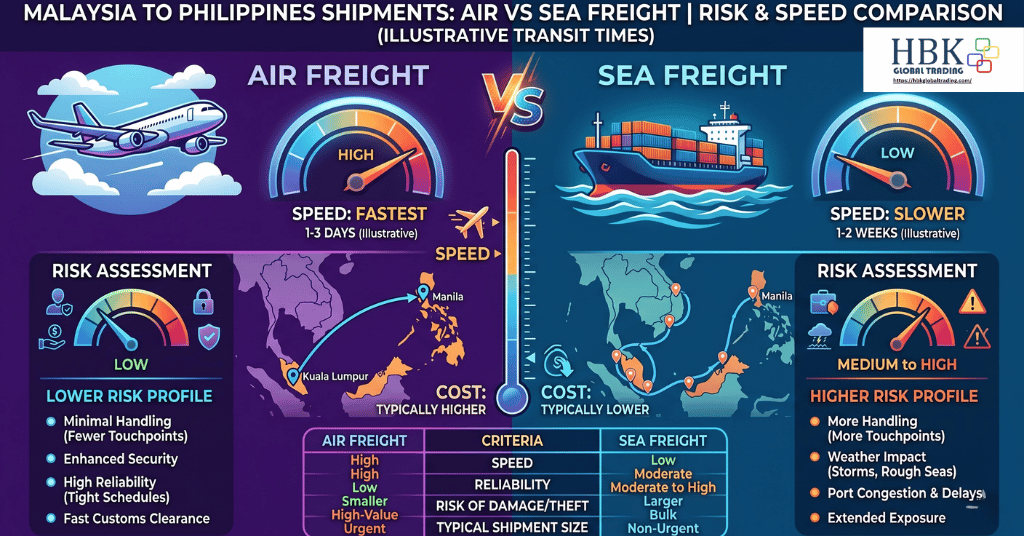
On paper, sea freight always looks like the smart, frugal choice. Then your container reaches Manila South Harbor and hits a Yard Lock. It ends up three rows deep behind other boxes while the demurrage clock runs without mercy. For temperature-sensitive serums and trend-driven electronics, every extra day in that Charge Pile eats the margin you shipped for.
And the damage isn’t only financial. A heat-soaked emulsion that separates in a hot container becomes a write-off no refund recovers. A phone accessory that lands after the hype cycle is just dead stock with shipping attached.
The HBK Fix: Malaysia to Philippines Air Shipping in 48 Hours
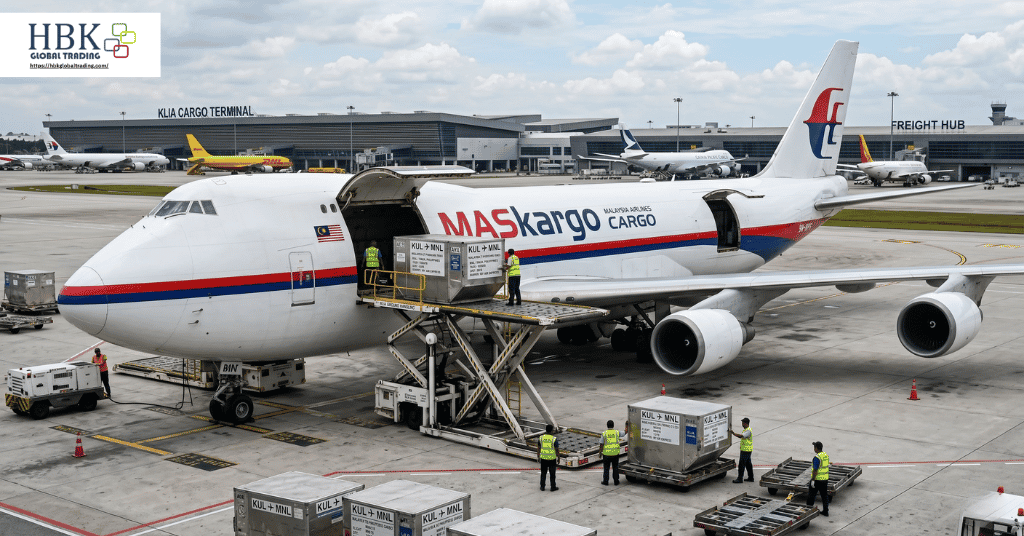
Our Malaysia to Philippines air shipping lane runs a dependable 24-to-48-hour transit window, wheels-up to wheels-down. We pair every booking with a Pre-Alert Protocol. That move locks your true landed cost before takeoff — duties, handling, the lot. No mystery line items ambush you at release.
The Hidden 2026 Trap: Form D Status and EVRIS Scrutiny
Here’s the part most importers completely missed. Between 1 and 6 April 2026, a technical fault knocked out Malaysia’s ASW Gateway. As a result, the country fell back on hardcopy Form D while the system stayed down. Then service returned on 6 April. It sounds like a footnote. But it wasn’t.
That short window left a tail of mismatched declarations across the system. Months later, the Bureau of Customs still cross-checks affected entries against e-VRIS valuation benchmarks. So when a declared value or origin document doesn’t line up, that’s a textbook Red Lane Trigger. Left unmanaged, a valuation dispute can escalate into a Warrant of Seizure and Detention (WSD). In short, your cargo freezes — and your capital freezes with it.
How We Keep Your Shipment Off the Red Lane
This is exactly where an insider beats a freight quote. On every manifest moving through our lane, we:
• Run a Description Scrub so the goods description, value, and HS code tell one consistent story to BOC.
• Verify your e-Form D transmission status before we file the declaration — not after, when fixes come too late.
• Confirm AHTN classification against the current BOC tariff reading, so nothing slips into a higher duty bracket.
The payoff? Clean entries, smoother clearance, and zero Audit Trap exposure down the line.

ATIGA Duty-Free — But Only If You Document It Right
Here’s the upside almost nobody fully claims. The ASEAN Trade in Goods Agreement (ATIGA) is the key. Under it, the Philippines charges zero or near-zero tariffs on roughly 99% of qualifying ASEAN-origin goods. In fact, Malaysian-made cosmetics, semiconductors, and electronics often qualify. But the discount hinges on one piece of paper.
That paper is a valid Form D, presented at entry. Miss it, and BOC charges the full MFN (Most Favored Nation) rate. You’d pay duty on goods that qualified to enter duty-free. Here’s the trap that catches first-timers: you can’t get a Form D after the fact. If it isn’t in the file before your cargo lifts off, that money is gone.
So we don’t leave it to chance. Instead, our team works directly with your supplier’s PCO issuing authority — the Preferential Certificate of Origin desk under MITI. From there, we secure the Form D, push the transmission, and match it to your shipment before takeoff. That way, we lock your savings in on the front end. And you won’t argue for them at the counter.