
By the HBK Customs Compliance Team | Updated June 2026
⚡ Quick Answer
• What it is: LCL (Less than Container Load) sea freight lets you ship Taiwan machine parts in shared container space, paying only for the cubic meters you actually use.
• Who it’s for: Importers and PEZA/BOI manufacturers moving roughly 0.5–15 CBM of crated components — too much for air, too little for a full container.
• How fast: About 7–12 days door-to-door Kaohsiung→Manila (the sailing itself is short; consolidation and clearance drive the timeline).
• The catch: Handled by the wrong forwarder, LCL invites Red Lane inspections, Yard Lock delays, and Charge Pile fees that quietly erase the savings. HBK’s vetted Kaohsiung lane is engineered to remove exactly those risks.
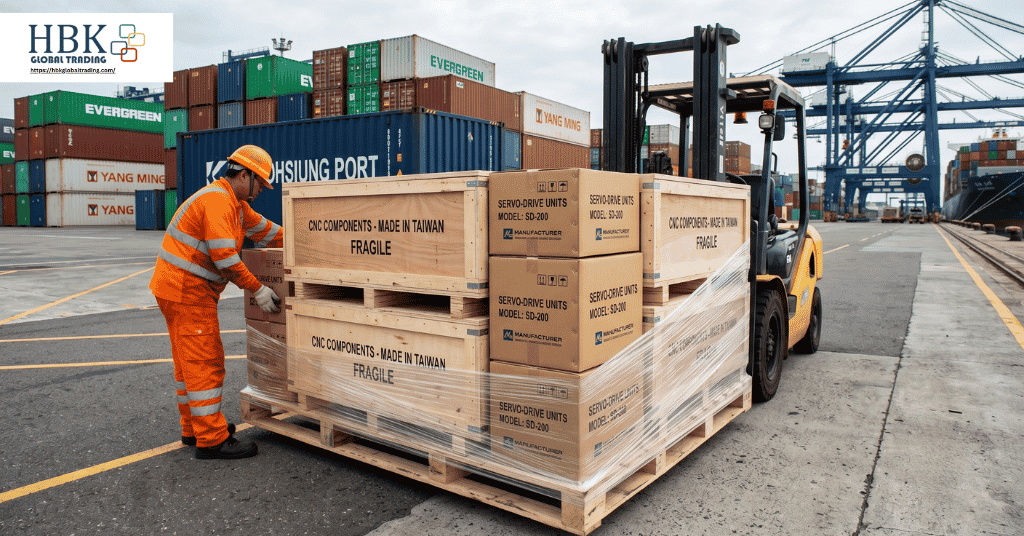
A single CNC spindle. Three servo motors. A pallet of hydraulic valves out of Taichung. If you’ve ever sourced industrial components from Taiwan, you already know the squeeze: air freight punishes your margin, and a full container demands volume you simply don’t have this month.
That gap is exactly where LCL Taiwan machine parts shipping earns its place in 2026. You pay for the space you use, your three pallets sail instead of waiting weeks to fill a box, and — done right — your production line never feels the delay.
Here’s the part most forwarders won’t tell you. Cheap LCL, handled carelessly, can cost more than booking your own container. The savings on paper evaporate the moment your crate inherits a stranger’s paperwork problem at the Port of Manila. In our years consolidating cargo for SME manufacturers, we’ve watched it happen — and we built our Kaohsiung-to-Manila lane specifically so it doesn’t happen to you.
WHAT LCL ACTUALLY MEANS FOR MACHINE PARTS
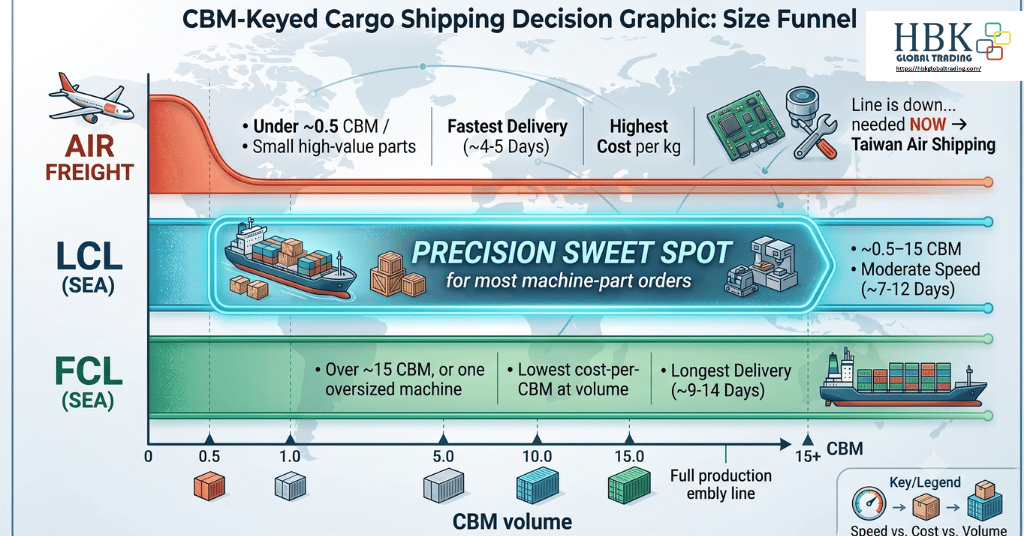
LCL (Less than Container Load) shipping lets you book only the cubic meters your cargo occupies inside a shared sea container, instead of paying for a full box. For Taiwan machine parts — CNC components, servo drives, linear guides, hydraulic valves — it’s the practical middle path when you have more than a few crates but far less than a 20-foot container’s worth. The sweet spot sits at roughly 0.5 to 15 cubic meters (CBM). Below that, small high-value parts usually ship faster and cheaper by air; above it, a dedicated full container tends to win on both cost-per-CBM and customs risk. The trade-off with LCL is shared risk: your goods move, and clear customs, alongside other shippers’ cargo. That makes carrier selection, accurate HS-code classification, and pre-arrival entry filing the decisive factors — not the headline freight rate. Handled well, LCL protects your margin and your production schedule at once.
Why Taiwan, Specifically
Taiwan doesn’t really make “parts” — it makes tolerances. Hiwin linear guides, Delta servo drives, ball screws cut to micron-level repeatability. These are the components keeping PEZA-registered plants in Cavite, Laguna, and Cebu running. You rarely need a full container of them; you need three pallets or eight crates. As precision-component demand keeps climbing — a trend we unpack in our Taiwan electronics sourcing guide — fractional sea freight is quietly becoming the default for smart importers.
THE PROBLEM: WHY “CHEAP LCL” BACKFIRES
The Hidden Cost of Commodity LCL
A poorly managed LCL shipment can cost more than your own container. Three risks drive it.
The Red Lane Trigger
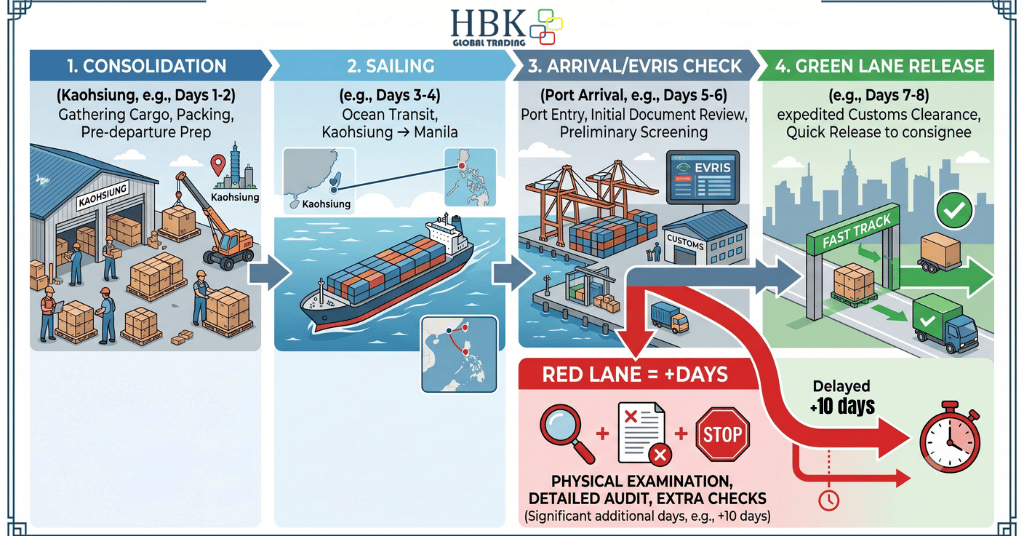
When a forwarder dumps your machine parts into a shared box with random consumer cargo, your shipment inherits everyone else’s risk profile. One suspect bill of lading, and the Bureau of Customs risk engine can flag the whole container for full physical inspection — the Red Lane — adding days of delay plus inspection fees to cargo that did nothing wrong.
HS Code Misclassification — and Why It Bites Harder for Taiwan
Machine parts live in one of the trickiest zones of the Philippine tariff book. Is your shipment a complete machine, a part under HS Chapter 84, or a general electrical component under Chapter 85? Your supplier’s invoice code is written for Taiwan export use — not Philippine import-duty calculation. Trust it blindly and you risk revaluation against the Bureau of Customs EVRIS value reference, or worse, a Warrant of Seizure and Detention (WSD).
Here’s the insider point: Taiwan has no free-trade-agreement cushion with the Philippines. Cargo from China can lean on an RCEP Form E, and ASEAN-origin goods on a Form D — preferential certificates that soften the duty. Taiwan-origin parts get no such cover, which means your HS classification has to carry the full weight on its own. Getting it right isn’t a nicety; it’s the whole game. We walk through the logic in our HS Code Philippines guide.
Yard Lock
A shared container is only de-vanned after every consignee inside it clears. If one co-loader has incomplete papers, your goods sit in Yard Lock while storage and demurrage charges quietly stack up against cargo you already paid premium freight to move.
The HBK Solution: Engineered LCL, Not Commodity LCL
How HBK Engineers the Box
We don’t just sell you space in a container. We engineer what goes in it, and what happens when it lands.
Curated Co-Loaders
Our Kaohsiung lane consolidates vetted B2B industrial cargo — not random consumer freight. Lower aggregate risk score, fewer Red Lane Triggers, faster Green Lane releases. It’s the same disciplined consolidation model we run in our auto parts importing playbook.
HS Code Lock + CREATE MORE Screening
Before your shipment leaves Taiwan, our compliance team verifies the correct 11-digit Philippine tariff classification against your actual product specs — the difference between a near-zero machinery line and a much steeper general-goods rate on the very same physical part.
We also screen every shipment for CREATE MORE Act (RA 12066) relief. If you’re PEZA– or BOI-registered, your capital equipment, spare parts, and accessories can come in duty- and VAT-free — but only when they’re directly attributable to your registered activity and backed by the correct PEZA VAT zero-rating certificate. We check your status against the current incentive rules every time, so the exemption holds up under a BIR post-audit instead of unraveling in one.
Pre-Alert Filing
Through the Bureau of Customs e2m system, we lodge your import entry before the vessel berths — clearing the runway for a faster Green Lane release instead of days lost to Yard Lock. That’s how we defuse the Charge Pile before it ever starts building. Need the clearance handled end-to-end? That’s our customs cargo-release service.
Taiwan LCL Shipping: Frequently Asked Questions
How long does LCL shipping from Taiwan to Manila take? Plan for roughly 7–12 days door-to-door. The Kaohsiung–Manila sea leg is genuinely short — under two days at sea — but LCL adds consolidation time before departure and de-vanning plus customs clearance on arrival. Accurate paperwork and pre-arrival entry filing are what keep that window tight.
Do Taiwan machine parts qualify for duty-free import under CREATE MORE? They can — if you’re a PEZA- or BOI-registered enterprise and the parts are directly attributable to your registered project. Capital equipment, spare parts, and accessories are eligible for duty- and VAT-relief, but VAT zero-rating now requires a valid PEZA certificate. Without registration and the right documentation, standard duties and 12% VAT apply.
Why do my parts keep getting flagged for Red Lane inspection?
Usually it’s risk by association. In commodity LCL, your crate shares a container with unrelated cargo, so one shaky bill of lading can flag the whole box for physical inspection. Consolidating with vetted industrial co-loaders — and filing clean, correctly classified entries — is the practical fix.
Is LCL cheaper than air freight for machine parts?
For most orders between about 0.5 and 15 CBM, yes — comfortably. Air only wins for very small, very urgent, high-value items where speed outranks cost. Below half a CBM, the math often tips back to air; above 15 CBM, a full container usually beats both.
Can HBK classify the HS code for me?
Yes — and for Taiwan cargo it matters more than usual, because there’s no FTA certificate to fall back on. Our team locks the 11-digit Philippine classification against your real product specs before the shipment sails, so duty is calculated correctly the first time.
Taiwan’s precision is wasted the moment it sits in a Yard Lock. The real LCL Taiwan machine parts advantage was never just a cheaper freight line — it’s a disciplined, document-tight, BOC-aware protocol that defends your production schedule and your margin at the same time.
That’s the standard your Taiwanese supplier machined into the part. It’s the standard we build into the shipment.
Keep reading from the HBK team:
- Sourcing High-Tech: Importing Electronics from Taiwan to the Philippines
- HBK’s Taiwan to Manila Air Shipping Service
- HS Code Philippines: A Guide to Correctly Classifying Imports
- Importing Auto Parts from China to the Philippines
- HBK Blog Index