
HBK Global Trading provides freight forwarding services that Philippines businesses use to bring cargo in from overseas suppliers, by air and by sea. We arrange the freight, prepare the paperwork, coordinate clearance with the Bureau of Customs, and deliver the goods to your address. You deal with one company across the whole route instead of managing a forwarder, a broker, and a trucker separately.
2011
Operating from Quezon City
9
Specialty Countries
Air + Sea
Air and sea on the same route
Official Consignee
We import the cargo in our name
We have been doing this since 2011 from our base in Quezon City. We act as the official consignee, which means the cargo is imported in our name. For a small business placing its first order with a supplier in Shenzhen or Bangkok, that removes the biggest barrier of all.
What's included
Here Is What We Take On For You
Air and sea freight on the same route, so you can weigh speed against cost
Customs clearance handled by our own compliance team rather than outsourced on arrival
Freight forwarding services covering carriers, warehousing, and transportation at both ends
Delivery services to Metro Manila, Cebu, Davao, and provincial addresses where the route allows
The role
What a Freight Forwarder Actually Does
Freight forwarding is the coordination of cargo movement from origin to destination. On a typical import into the Philippines, that means booking space with a carrier, handling shipping line logistics and trucking at both ends, consolidating cargo at a warehouse, lodging customs documents, and organizing final delivery. A forwarder does not own the vessels and planes. The job is keeping every party in that chain working to the same schedule and the same paperwork.
Where we sit in that chain is what separates a working forwarder in the Philippines from a booking agent. Our international logistics operations start at origin: we run consolidation hubs in Asian main export countries, so your supplier delivers to a warehouse we operate rather than to a third party we have never met. We also keep the customs work with our own compliance team, so the people preparing your entry are the same people we can call when the Bureau of Customs raises a question.
Because we consolidate volume across many shipments, we can also leverage rates and sailing options which a single importer moving a few pallets could not negotiate alone. The real benefit shows up when something goes wrong — a typhoon, a port backlog, a document query. Global logistics is unpredictable, and a forwarder with several carriers and modes available can reroute a shipment while one with a single option can only tell you to wait.
▶ Get Freight Forwarding SupportWhere We Sit in the Chain
Shipping modes
Air, Sea, LCL, and Full Container Load
Air Freight
For Urgent Cargo
Air freight makes sense for time conscious shipments, where the arrival date matters more than the cost per kilo. It suits urgent goods and replacement parts, high-value items and electronics, samples and small commercial orders, and fast-moving stock you cannot afford to run out of.
The trade-off is straightforward. Air costs more per kilo, and a fast flight still needs clearance and local delivery arranged on the Philippines side. Timely deliveries depend on that second half being planned before the cargo departs, not after it lands. More on our Air Shipping Service page.
Sea Freight
For Volume and Weight
For heavier or less urgent cargo, sea freight usually has better economics, which is why most business inventory arrives that way. It carries far more for the money. The trade-off is transit time, which commonly runs several weeks and will vary with route, carrier, and port schedule.
Sea freight suits bulk cargo and regular inventory, machinery, furniture, equipment, construction materials, and any commercial shipment where cost matters more than speed. Cargo may arrive through the Port of Manila, Subic Bay, or another gateway depending on the carrier.
LCL Shipping
Less Than Container Load
LCL, or less than container load, is for cargo that does not fill a container. Your goods share space with other shipments and you pay for the volume you use, measured in cubic meters. It is the sensible starting point for smaller importers, online sellers, and anyone testing a product before committing to volume.
Full Container Load
FCL
FCL gives your cargo an entire container, usually a 20-foot or 40-foot box. It suits higher volumes, machinery, and businesses moving inventory on a regular cycle. Past a certain quantity it costs less per unit, and the container stays sealed from origin to destination.
Clearance
Customs Clearance & Brokerage Coordination
Cargo that has landed is not cargo you can collect. It stays at the port or airport until the entry is lodged, duties and taxes are assessed, and any required permits are on file. This is where most import delays actually happen, and it is why we keep a customs compliance team in-house rather than handing shipments to a stranger at the terminal.
Duties, taxes, and customs charges depend on the HS code, the declared value, the country of origin, the product type, and the rules in force at the time. We review those before quoting, so your figure reflects landed cost rather than freight alone. Clearance timelines vary by shipment and cannot be guaranteed by anyone, which is why we prepare documents ahead of arrival — storage charges can accrue while paperwork is sorted out.
Documents we commonly work with:
1
Commercial invoice and packing list
2
Bill of lading (sea) or air waybill (air)
3
Product description, country of origin, and declared value
4
Permits, where the goods are regulated
5
Delivery details for the final leg
Coverage
Shipping Routes & International Markets
China is our flagship lane, backed by our own hubs in Guangzhou and Shenzhen, but it is not the whole map.
We ship from nine international markets across Southeast Asia and East Asia by sea, and for most of them, by air as well:
The last mile
Domestic Distribution Across the Philippines
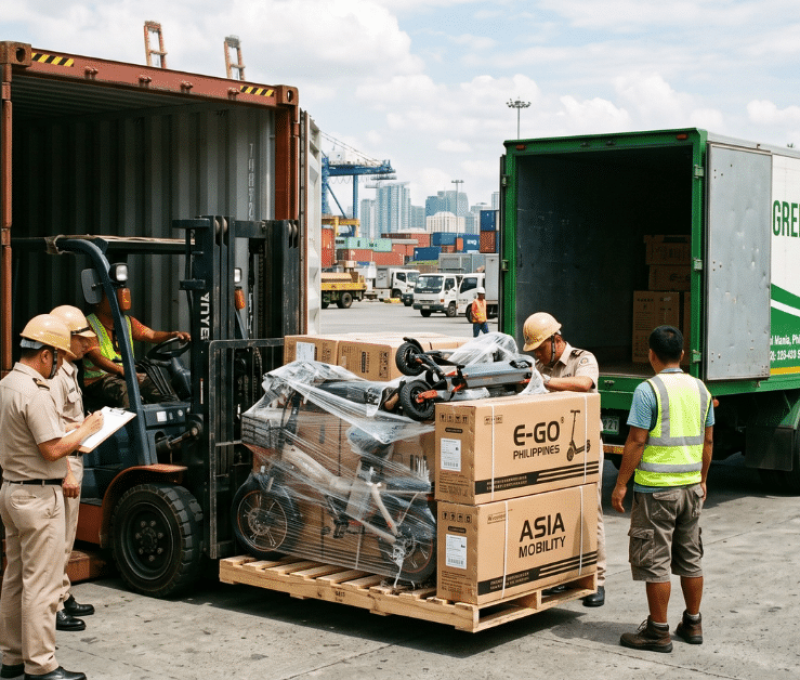
Plenty of our clients are not in Metro Manila. They are running a store in Cebu, a project site in Davao, or a business somewhere in the provinces. A shipment only counts once it reaches the address on the invoice, so we treat domestic distribution as part of the job rather than a handoff.
The Manila International Container Terminal handles most container traffic, with the Port of Cebu and Subic Bay serving certain routes. The Subic Bay Freeport Zone works differently, since qualifying goods move duty-free within the zone. From those ports your cargo still needs handling, trucking, and sometimes warehousing. Transportation across an archipelago is never cheap — geography adds cost and port congestion is a real scheduling factor — so we plan the local leg alongside the international one.
Trucking and land transport to warehouses, stores, offices, homes, and project sites
Provincial delivery where the route allows
Direct service to Cebu and Davao
Delivery within Metro Manila
Pricing
What Affects Your Freight Cost
The honest answer to “how much will this cost?” is that it depends, and anyone quoting a flat number before seeing your cargo details is guessing. The variables that move the figure are:
01
Shipping mode — air or sea
02
Weight, dimensions, and volume in CBM
03
Origin country and destination in the Philippines
04
Port or airport handling
05
Customs charges, duties, taxes, and any required permits
06
Trucking, warehousing, and final delivery
07
Special handling, insurance, and how quickly you need it
Give us accurate cargo details, documents, origin, destination, and preferred mode, and we search the available sailings and flights before putting a number in writing. Many shipments run on a pay-on-arrival basis, so you settle once the cargo lands rather than up front.
Get a quote
What to Send for a Quote
The more complete your details, the sharper our numbers:
Air Freight
For Urgent Cargo
Air freight makes sense for time conscious shipments, where the arrival date matters more than the cost per kilo. It suits urgent goods and replacement parts, high-value items and electronics, samples and small commercial orders, and fast-moving stock you cannot afford to run out of.
The trade-off is straightforward. Air costs more per kilo, and a fast flight still needs clearance and local delivery arranged on the Philippines side. Timely deliveries depend on that second half being planned before the cargo departs, not after it lands. More on our Air Shipping Service page.
Sea Freight
For Volume and Weight
For heavier or less urgent cargo, sea freight usually has better economics, which is why most business inventory arrives that way. It carries far more for the money. The trade-off is transit time, which commonly runs several weeks and will vary with route, carrier, and port schedule.
Sea freight suits bulk cargo and regular inventory, machinery, furniture, equipment, construction materials, and any commercial shipment where cost matters more than speed. Cargo may arrive through the Port of Manila, Subic Bay, or another gateway depending on the carrier.
FAQs
Freight Forwarding Philippines FAQs
Ready to Ship?
Tell us what you are bringing in and we will take the logistics from there. Whether it is
a single test order or containers on a schedule, we will review the shipment
and recommend the practical way to move it.