
By the HBK Global Trading Customs Compliance Team | Updated June 2026
⚡ Quick Answer
• What it is: Trade financing that covers part of your supplier payment, so you don’t drain your cash to restock.
• How much: Up to 50% of your supplier invoice at a flat 5% interest—charged only when your goods arrive, never upfront.
• Who qualifies: Importers approved by HBK, with the supplier vetted first. Funds go to verified business accounts only.
• Where: Any country we ship from.
Right now, every peso in your account feels like a lifeline. Inflation is running at multi-year highs, and the peso keeps testing record lows against the dollar. Filipino business owners are responding the sensible way: they hold cash and stay liquid. The trouble is that staying liquid and restocking now feel like opposites. That tension is exactly why import financing in the Philippines matters more than ever.
But the trap is quiet. Your supplier still wants payment in full, your shelves still need restocking—and the moment you drain your reserve for one big order, the cushion that keeps you safe is gone.
This is where HBK Global Trading changes the math. Through our import financing service—a simple form of trade finance built around your shipment—we front up to half of your supplier payment, so you secure your goods today without emptying your account.
Why Filipino Importers Are Sitting on Their Cash
The squeeze comes from three directions at once. Borrowing got expensive: the Bangko Sentral ng Pilipinas has been hiking its benchmark rate—its first increases in two years—and another move may be coming. So bank credit lines cost more than they did a year ago.
Then there’s the peso. Because suppliers invoice in dollars, a weaker peso quietly makes every order cost more—and your working capital stretches thinner with each shipment.
And formal credit is simply out of reach for most. By recent industry estimates, roughly 57% of Philippine MSMEs still lean on informal lenders at punishing rates. Faced with all this, many owners just freeze. They sit on their cash and delay orders, hoping to outlast the storm
The Hidden Cost of Waiting
Holding cash feels safe. Yet waiting carries its own price tag. Suppliers reward early commitments with better pricing, and those slots fill fast. Meanwhile, the competitors who restock now will own the shelf space when demand returns.
The real question is not “spend or save.” It’s this: how do you buy what you need and keep your reserve intact? That’s the problem we built our financing service to solve.
The Second Cash Hit Most Importers Forget
Most importers budget for one payment. There’s a second one waiting at the port.
This 2026, the Bureau of Customs is chasing a record ₱1.003 trillion collection target. Its examiners now check every declared value against URMS and EVRIS benchmarks, so lowball invoices no longer slip through. We broke this down fully in our guide to the 2026 valuation crackdown.
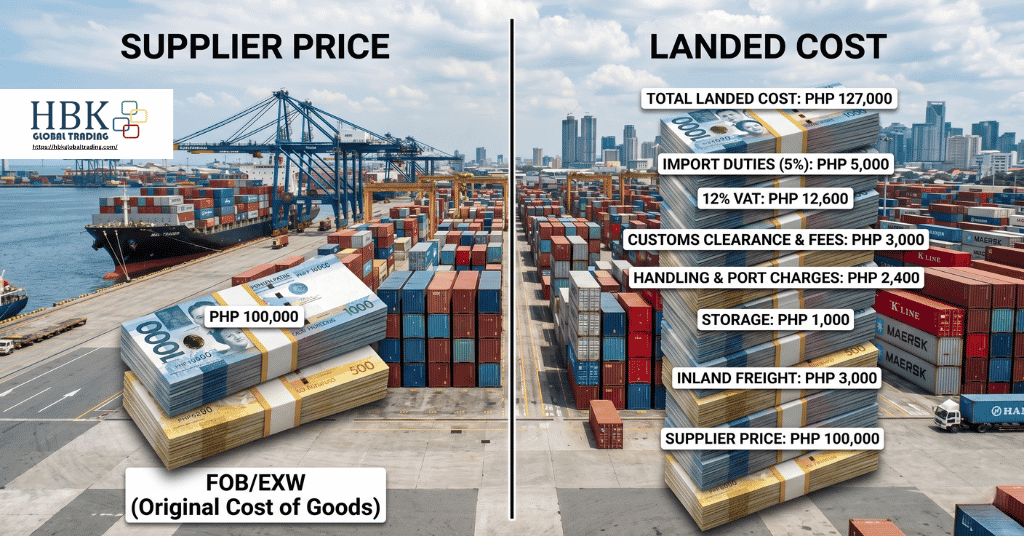
The takeaway is simple. Your declared customs value is climbing, and your duties plus 12% VAT climb with it. Your true cash need is your landed cost—not just your supplier price. We unpack that exact trap in the landed cost myth
And the timing is brutal. Those duties fall due at clearance, right after your supplier payment has drained your account. A single value mismatch can pull the shipment into a Red Lane inspection. Miss the payment window and the cargo sits: the Charge Pile grows by the day, and a Yard Lock can freeze your goods entirely.
Picture a common case. An importer brings in ₱400,000 worth of electronics, pays the supplier in full, and feels on top of things—until the duty-and-VAT bill lands at clearance and the account is already empty. The goods sit while they scramble for funds. A week of storage later, the “savings” from skipping financing are gone, eaten by the Charge Pile
How HBK Import Financing Keeps You Liquid
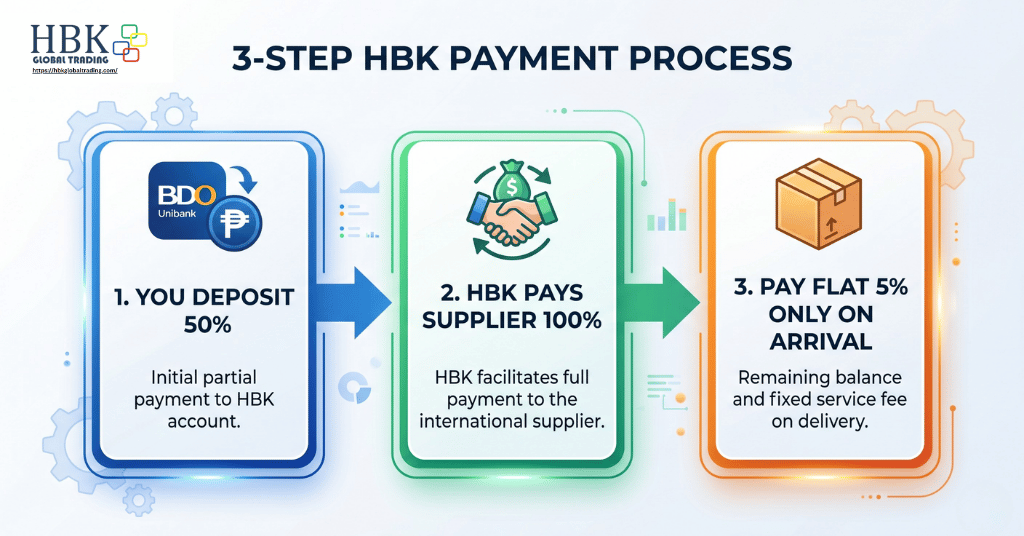
The model is simple by design. We finance up to 50% of what you owe your supplier, from any country we ship from. You cover your half; we cover ours. In practice it flows like this:
• You deposit your share into our Peso BDO account.
• Once your portion clears, we release the full supplier payment.
• Your goods get produced and shipped on schedule.
• We charge a flat 5% interest on the financed amount—and only when the item arrives. That last point is the one that matters. We never charge a single centavo until your goods are ready for pickup. With the interest sitting on the back end, your cash stays in your business through the entire transit window—which means you keep enough on hand for the duties and VAT waiting at clearance. Used this way, import financing keeps you liquid exactly when it counts.
A Real Example
Take a scenario we handle constantly. Your supplier invoice totals $10,000, and we finance up to $5,000 of it. You deposit your $5,000 share, we send the full payment, and your order moves. The 5% charge applies only to the financed half, and it lands on your invoice at pickup—bundled with your shipping cost. So your reserve stays ready for the clearance bill.
Import Financing vs. Your Other Options
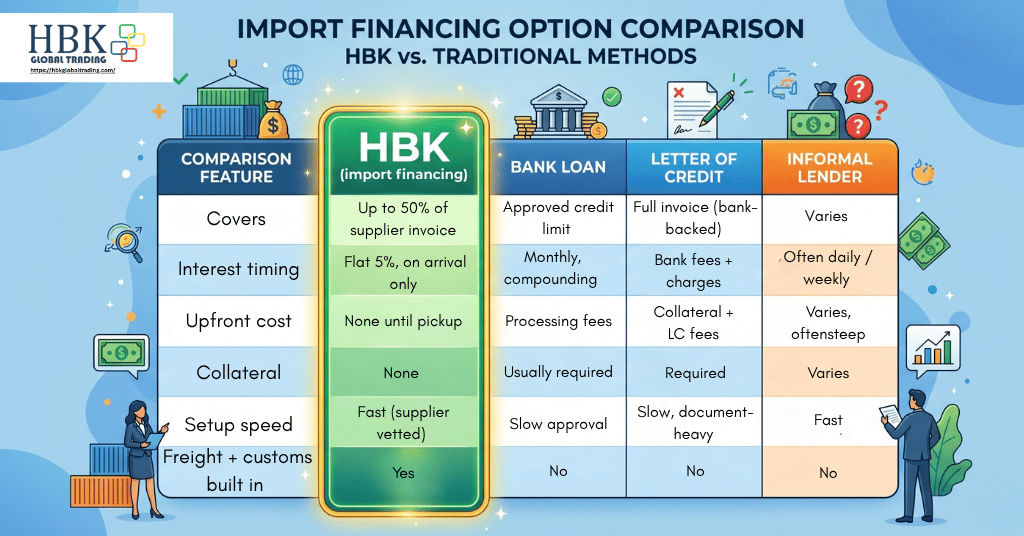
During a hiking cycle, the contrast is sharp. A bank revolving line or working-capital loan charges interest monthly, and that cost compounds while your goods sit on the water. A letter of credit (LC) ties up collateral and buries you in bank paperwork. An informal lender moves fast, but the rates can be punishing and the terms opaque. Here’s how they stack up:
The difference is that our financing is built around the shipment itself—no monthly accrual, no surprise fee, just one flat charge at the finish line. Better still, you deal with a licensed customs broker who already handles your freight, your clearance, and your supplier relationship end to end.
Who Qualifies, and How We Protect You
Our customs team clears hundreds of millions of pesos in cargo every year, so we protect your money as carefully as our own. Before any payment leaves, we contact your supplier directly and vet them first. That single step shields you from fraud and bad actors.
A few ground rules keep the program safe. Financing runs upon approval by HBK Global Trading, and we qualify both the client and the supplier. The approved amount is not always the full 50%, since we judge each deal on its merits. And we deposit only to verified business accounts—never to personal ones.
Frequently Asked Questions
How much does HBK import financing cost?
We finance up to 50% of your supplier invoice and charge a flat 5% interest on that financed amount. You pay it only when your goods arrive—there’s no upfront cost and no monthly compounding.
Who qualifies for import financing?
Any importer approved by HBK Global Trading. We assess both you and your supplier, vet the supplier directly, and release funds only to verified business accounts. The approved amount depends on the deal.
Which countries does the financing cover?
Any country we ship from. If we can move your cargo from origin to Manila, we can structure financing around it.
When do I pay the interest?
Only when your goods are ready for pickup. Nothing is charged upfront or during transit—the flat 5% lands on your invoice at arrival, bundled with your shipping cost.
Stay Liquid, Keep Growing
You don’t have to choose between staying liquid and growing your business. In a market this tight, the smartest importers do both—they guard their cash, secure their stock early, and keep a reserve ready for clearance. That’s the quiet advantage of import financing in the Philippines right now.
Before your next order ships, talk to us. We’ll review your supplier, your volume, and your timeline, then build a financing structure that keeps your reserve intact.
Tell us about your next shipment and we’ll map out the numbers.
Have questions first? Reach our team and we’ll walk you through it.
Links & Resources