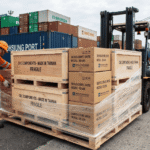
Not long ago, a client in Cebu asked us to quote LCL for a solar power system he was importing from China: panels, batteries, inverters and mounting parts. When we measured the order, it came to 54 CBM. We recommended a full container instead. He agreed, and the goods reached his doorstep in Cebu 20 days later. The reasons behind that call are the same ones that decide most LCL vs FCL China to Philippines questions we get.
A full container can start to make sense well before your cargo actually fills it. Whether it does depends on your packed volume and weight, how the goods need to be handled, what each quotation really covers, and where in the Philippines the cargo has to end up.
We have been moving business cargo from China to the Philippines since 2011, and the switching point is rarely where importers expect it. Two shipments of the same size can end up on different shipping methods because one is stackable cartons and the other is crated machinery. Your supplier’s location, your cargo-ready date and whether your site can take a container all move the answer too. Below, we put both shipping options side by side and walk through how we actually make the call.
What LCL and FCL Mean for Your Shipment
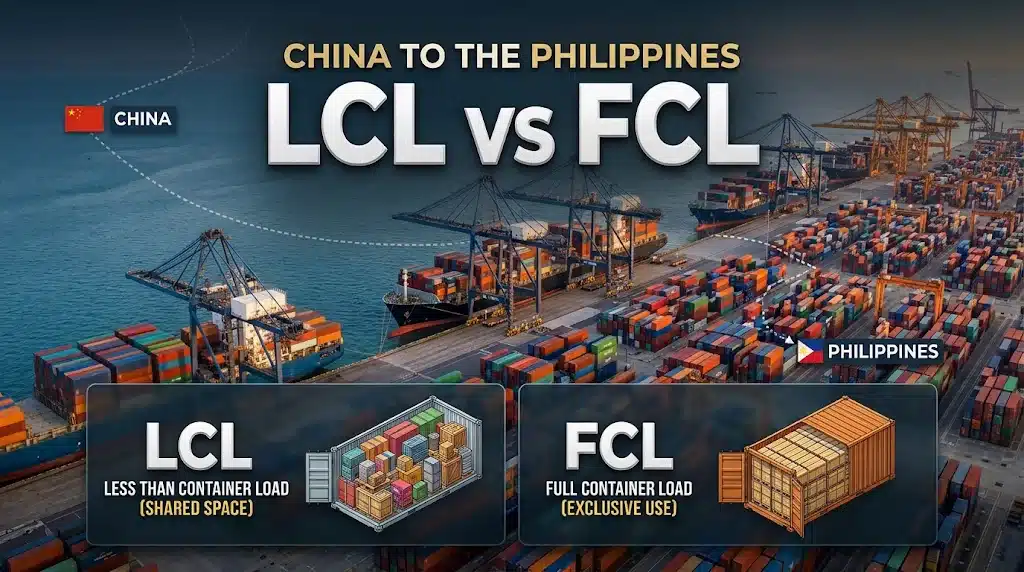
LCL (less than container load) means your cargo shares container space with shipments from other importers. You pay for the space or weight you use, measured in CBM (cubic meters: length × width × height of each package, in meters). The shared container is packed and unpacked at a container freight station (CFS), a warehouse where cargo is grouped before sailing and separated after arrival. On the China side, our consolidation warehouses in Guangzhou and Shenzhen receive your supplier deliveries and prepare them for LCL sea freight.
FCL (full container load) means you book an entire container for your goods alone, usually a 20-ft or 40-ft unit. It does not have to be full. You pay for exclusive use of that one container, whether your cargo fills half of it or the whole container. Both options are ocean freight on the same vessels; the difference is in how your goods are packed, charged, handled and delivered.
| Factor | LCL | FCL |
| Container use | Your cargo shares container space with other importers’ goods | The entire container is booked for your shipment only |
| Freight-pricing basis | Charged per CBM or by weight, whichever is greater (W/M) | Charged per container, however full it is |
| Consolidation handling | Loaded and unloaded with other cargo at a CFS at origin and destination | Loaded for you alone; no other shipments in the same container |
| Delivery considerations | Released after deconsolidation; delivered as loose cartons or pallets | Delivered as a container or unloaded at a warehouse first; the empty container is returned where applicable |
You can find the full service details on our LCL shipping and FCL shipping pages.
Why There Is No Fixed Shipment Size for Switching to FCL
Importers often ask us for one magic CBM figure. We understand why; it would make planning much easier. But a single threshold ignores three things that regularly change our recommendation.
Packed volume, not product volume
The shipment should be assessed as it will actually travel: final carton dimensions, plus any pallets, crates or protective packaging. Supplier figures sometimes describe the product rather than the packed cargo, and a few centimeters per carton, multiplied across a few hundred cartons, can move your cargo volume more than you would think. That is why we always work from packed dimensions. It is what gets measured when the goods reach our warehouse.
Cargo weight and physical fit
LCL sea freight is usually charged on a weight-or-measurement (W/M) basis.
Your shipment volume in CBM is compared with its gross weight in metric tonnes, with 1,000 kg treated as equal to 1 CBM, and you are charged on whichever is higher.
So dense cargo like tiles, batteries or machinery can be billed on cargo weight even when it takes up little space. Our guide on how weight and measurement affect LCL pricing goes deeper into this.
Weight and stacking also limit what fits inside a container. Its published capacity is not the same as the space your cargo can practically use. If crates cannot be stacked, or the load hits the weight limit before the space runs out, part of the FCL container stays empty no matter the cargo size.
The cost crossover
The LCL/FCL break even point comes from the actual quotations in front of you and the scope each one covers, not from a generic rate table, and both the LCL cost and the container rate vary depending on season, origin, destination and delivery requirements.
A common shipping industry rule of thumb puts the crossover somewhere around 13 to 15 CBM, and on our own LCL page we describe roughly 15 CBM as a working rule for where LCL tends to keep its cost advantage.
We treat that range as a cue to quote both options, not as a line that settles anything. Heavy, fragile or time-sensitive cargo can justify a comparison well below it, while light, flexible cargo can sit comfortably in LCL above it.
Compare LCL and FCL Costs for the Same Delivery Scope
The mistake we see most often with FCL vs LCL shipping costs is comparing shipping rates at face value: an LCL rate per CBM against a container freight rate. Neither number is the total cost of getting your goods delivered. For a fair comparison, both quotations have to cover the same cargo, from the same pickup point, to the same Philippine address. Check how each one handles:
- Origin services: pickup from your Chinese supplier, warehouse receiving and export handling.
- Ocean freight: the sea freight rates for the voyage itself.
- Destination handling: port and terminal charges, plus CFS handling and deconsolidation for LCL.
- Inland or domestic delivery: trucking, or onward shipping to Visayas and Mindanao, from the destination port to your warehouse, store or project site.
- Customs-related services, duties and taxes: whether a customs broker or clearance service is included, and whether import duties and VAT are included, estimated or billed separately.
The differences that usually tip the decision sit at the destination. LCL destination charges and CFS handling are often calculated per CBM or per shipment, so your LCL charges climb as your volume grows. FCL brings its own items: container trucking, a site that can take a container truck, and returning the empty container. For large shipments FCL is usually cheaper per unit, but a low freight rate on either side can still turn out to be the more expensive option once everything is added.
One practical habit that saves a lot of grief: ask every provider to list, in writing, the charges excluded from the quotation. That single request heads off most of what importers call hidden fees, especially when destination work is passed to local agents whose charges sit outside the original quote.
You can read more about what an all-in freight quotation includes. When we prepare both options for a client, we price them against the same scope so you can see, line by line, which one is more cost effective for that shipment.
Sea freight rates from China move with the season, fuel costs and vessel space, so we don’t publish a fixed rate card here. Any figure printed on a blog page would likely be out of date by the time you read it.
For our current LCL rate per CBM and FCL container rates from China to the Philippines, contact our team. Send your packed dimensions, gross weight and delivery address, and we will quote both options against the same delivery scope.
When FCL Becomes More Practical Than Shared Space
Sometimes FCL is worth a look even with unused space left in the container. The reasons tend to be operational rather than purely financial.
Handling and the risk of cargo damage
LCL cargo is loaded, unloaded and moved alongside other shipments at the CFS on both ends. An FCL container, by contrast, is normally sealed at origin and opened at destination, unless customs selects it for examination. For fragile or high value goods, that reduced handling can lower the risk of cargo damage or loss. It does not remove it, though. FCL cargo still needs sound packing and securing, and any shipment, LCL or FCL, can be pulled for customs inspection.
Consolidation, co-shippers and customs delays
LCL cargo moves on the consolidator’s schedule and is only released once the whole container has been unpacked at destination. If another importer’s goods in the same container run into customs issues, the release of everything else can be held up too. With FCL there is one consignee and one set of papers, which generally makes customs clearance simpler to coordinate.
Simpler is not the same as faster, though. Vessel schedules, port congestion and customs delays affect both options. The sailing itself from South China ports to Manila is often only a week or two, but the full shipping timeline also includes consolidation, loading, discharge at the destination port, clearance and trucking. From our Asian origin markets, ocean freight typically runs around 21 to 30 days in total, depending on route, vessel schedule and clearance. Our article on sailing time versus complete delivery time breaks this transit time down step by step.
Customs documents: what changes and what doesn’t
Philippine customs asks for the same core customs documents whichever way you ship: mainly the commercial invoice, packing list and bill of lading, plus any permits your product needs. The shipping method does not change your duty rate either. Import duties and VAT depend on the product’s HS code and customs value, and since the 12% VAT is computed on a base that starts from the CIF value (cost, insurance and freight), the freight you pay becomes part of that base. Only very low-value shipments fall under the ₱10,000 de minimis threshold, so commercial cargo, LCL or FCL, should expect duties and taxes.
Documentation errors hurt either way. Get the HS code wrong and the duty and VAT come out wrong with it. That is why our in-house customs compliance team reviews documents while the cargo is still in transit, not after it lands.
Where your cargo needs to end up
This is where Philippine conditions matter most, and it is exactly what decided the Cebu solar shipment we mentioned at the start. Our LCL cargo is released through our Manila facility. For a client in Cebu, LCL would have meant unloading his panels, batteries and inverters in Manila, then handling them again for the domestic leg south. At 54 CBM, the order was also well past the usual crossover range. Shipping it FCL meant less handling for fragile panels and heavy batteries, the kind of cargo you want touched as few times as possible, and the shipment could be delivered to his location in Cebu as one load. Door to door, it took 20 days. That was this shipment’s result, not a standard promise, since every route and sailing is different, but it shows what fewer handoffs can do for a provincial delivery.
Panels, batteries, inverters and mounting parts from China, delivered to the client’s location in Cebu as one load.
Batteries also deserve a mention of their own. Depending on their type, they can be classified as dangerous goods, which affects how they are declared, packed and accepted for shipping. That is one more reason to raise them at the quotation stage, not after the cargo is ready.
Delivery within Metro Manila has its own checks. A container truck needs road access, space to park and delivery windows that suit your destination address, and truck restrictions and narrow streets can shape when it can reach you. Someone also needs to unload within the allowed free time before the empty container goes back. If your site cannot take a container, FCL cargo can be unloaded at a warehouse first and delivered by smaller trucks, which changes the cost comparison. Our notes on warehouse readiness for an FCL delivery and choosing a suitable container size cover this in more detail. For Cebu, Davao and other provincial destinations, we coordinate the onward leg through our nationwide delivery service.
Your restocking rhythm
Finally, think about how your business actually buys. Regular, smaller replenishment orders often suit LCL shipments, while large seasonal batches lean toward FCL shipments. And if speed matters more to you than volume, it may be worth stepping back to compare air and sea freight from China . For urgent cargo, our air freight from China typically dispatches within 48 to 72 hours of arriving at our China facility.
How Similar-Sized Shipments Can Lead to Different Choices
The Cebu shipment was a clear-cut case. Closer calls happen when two shipments are the same size on paper. The two examples below are hypothetical, not actual HBK customer shipments, but they reflect the kind of comparison we make for clients.
Example 1: Retail inventory in stackable cartons
A Quezon City retailer is importing about 12 CBM of household goods from two suppliers in Guangdong. The cartons are light, uniform and stack well, and the store can take delivery on any weekday. LCL may remain the better fit here, as long as the complete LCL quotation, destination charges included, stays favourable against FCL for the same scope. Having both suppliers deliver to one consolidation warehouse also lets the cartons travel together as a single shipment.
Example 2: Machinery crates of a similar size
A manufacturer in Laguna is importing roughly the same 12 CBM, but as wooden crates of heavy machine parts that cannot be stacked. The gross weight pushes up the W/M charge, the crates need a forklift, and shared CFS handling adds risk. Comparing FCL makes sense here, subject to suitable equipment, cargo acceptance and a receiving site with a forklift and room for a container truck.
Same cargo volume, different recommendations. Cargo weight, stackability, handling needs and the delivery site made the difference, just as the destination did for our Cebu client.
Ask HBK to Assess Your China Shipment
If you are comparing forwarders, the right freight forwarder should be willing to quote both options against the same scope and tell you honestly which one fits. That is what we do. If you are weighing when to switch from LCL to FCL, send us these details and we will compare LCL vs FCL shipping from China for your actual delivery requirements:
- Product description and package count.
- Packed dimensions and gross weight.
- Stackability and any handling requirements (and whether batteries or other regulated items are included).
- Supplier location and cargo-ready date.
- Philippine delivery address and required delivery date.
- Agreed shipping terms (such as EXW or FOB) or an existing supplier quotation, where available.
With these, we can see how your cargo will pack, whether weight or volume will drive the LCL charge, whether your site can receive a container, and what each quotation needs to include. If your Chinese supplier has already quoted freight, share it with us and we will point out what it leaves for you to arrange on the Philippine side.
Since 2011, HBK has handled the full chain for Philippine importers: supplier pickup, consolidation, sea freight, customs clearance through our in-house customs compliance team, and delivery to your door, including Visayas and Mindanao. Where applicable, we act as importer of record, and you are not charged until your cargo lands. Learn more about shipping from China to the Philippines, or contact us and ask whether LCL or FCL better fits your next shipment.