By the HBK Customs Compliance Team | Updated January 20, 2026
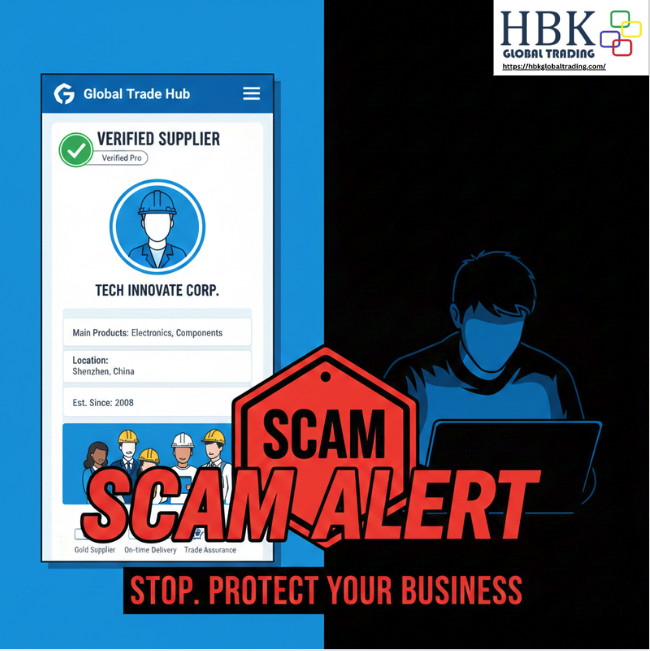
As Philippine trade volumes hit record highs in 2026, a sophisticated new threat has emerged for SMEs: the “Phishing Forwarder.” These are highly organized scammers who use AI-generated websites and forged DTI certifications to impersonate legitimate logistics partners. In the first few weeks of 2026 alone, several local importers have reported significant losses due to “intercepted” billing and fake container releases.
At HBK Global Trading, we believe that transparency is the best defense. Maintaining a secure supply chain requires more than just moving cargo; it requires a rigorous “Trust & Verify” protocol. Below, we break down the red flags of 2026 logistics scams and the steps you must take to ensure your partner is legitimate.

The Anatomy of the 2026 “Phishing Forwarder” Scam
Unlike the crude scams of previous years, the 2026 “Phishing Forwarder” doesn’t just ask for a wire transfer. They often gain access to legitimate email threads between you and your supplier. Once inside, they spoof the forwarder’s identity to send a “Revised Billing Statement” for port fees or storage charges.
These scammers take advantage of the complexity in calculating true landed costs, adding “urgent” administrative surcharges that appear legitimate but are actually linked to personal bank accounts or untraceable crypto-wallets.
The “Urgent Port Fee” Trap
A common tactic involves sending a fake Bureau of Customs (BOC) notice claiming that your container is under “Security Alert” and requires an immediate “clearance fee” to avoid seizure. Legitimate partners like HBK Global Trading will never ask you to pay a government fee into a private account. All BOC-related payments are processed through authorized agent banks and the e2m (Electronic-to-Mobile) system.
The HBK “Trust & Verify” Checklist
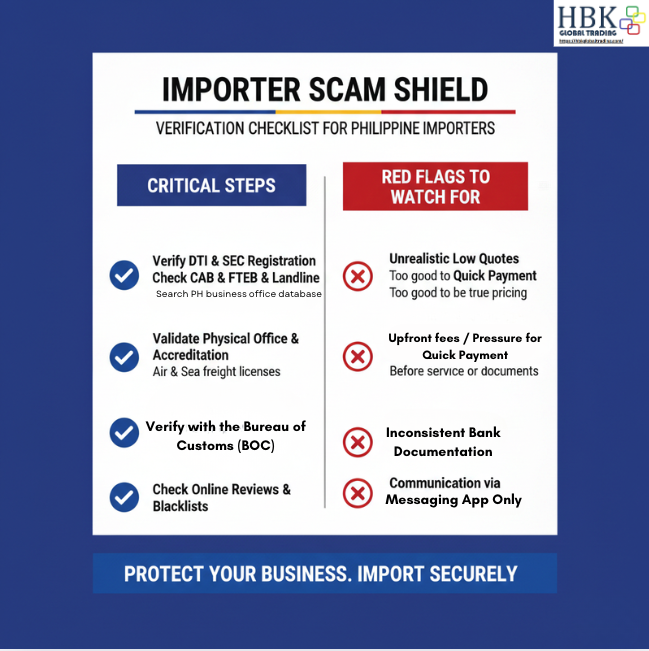
To stay protected, every Philippine business owner should apply this 3-point verification protocol before releasing funds or sensitive shipping documents.
- Verify the DTI & PAB Accreditation: In 2026, a basic DTI permit is not enough. A legitimate international freight forwarder must be accredited by the Philippine Accreditation Bureau (PAB) and the Fair Trade Enforcement Bureau (FTEB).
- Cross-Check the Physical Hub: Scammers rarely have physical warehouses. Before starting a long-term partnership, ask for a virtual tour or the exact location of their consolidation hub. At HBK Global Trading, our physical presence is a cornerstone of our reliability, allowing us to manage LCL and FCL shipments with full accountability.
- Audit the Communication Channel: Check the “From” address on every invoice. Scammers often use domains that are one letter off (e.g., hbkglobal-trading.com instead of hbkglobaltrading.com).
Beyond the Screen: Verifying Your Overseas Origins
The risk of fraud isn’t limited to the Philippines. Many scams originate during the sourcing phase in China or other Asian hubs. If a forwarder claims they can handle your imports but cannot explain how to verify Chinese suppliers, they likely lack the infrastructure to protect you.
A true partner provides end-to-end visibility. When you work with HBK Global Trading, we don’t just handle the customs clearance process; we verify the integrity of the entire documentation chain—from the Bill of Lading to the final Gate Pass.
What to Do If You Suspect a Scam
If you receive a suspicious invoice or a request for payment into an unknown account, freeze all transactions immediately. Contact your primary logistics contact through a verified phone number—never the number provided in the suspicious email.
The Philippine government has intensified its crackdown on maritime fraud in 2026. You can report suspicious logistics activity directly to the DTI Consumer Care portal or the Cybercrime Investigation and Coordinating Center (CICC).